The Industrialization of Cricket Fraud: Transnational Syndicates, Cyber-Enabled Ticketing Schemes, and Selection Exploitations
The Threat Landscape of Modern Cricket Fraud
The hyper-monetization of cricket, catalyzed by the global popularity of franchise leagues like the Indian Premier League (IPL), has transformed the sporting landscape into a high-value target for sophisticated, transnational criminal networks. No longer limited to localized street-level bookmaking, contemporary cricket fraud represents a highly organized, digital-first criminal economy. These operations exploit the extreme emotional investment, urgency, and aspirations of fans and young athletes alike. The modern threat matrix spans several distinct vectors: cyber-enabled ticketing operations, malicious media delivery networks, highly sophisticated transnational online betting syndicates, staged “synthetic” sports tournaments, and predatory career selection rackets.
At the core of this criminal industrialization is the exploitation of digital infrastructure. Fraudsters utilize automated software clone scripts, generative artificial intelligence (AI) face and voice-cloning tools, and decentralized messaging platforms to scale their reach, target vulnerable demographics, and layer illicit financial flows through complex transnational networks. Investigating these distinct but interconnected fraud vectors reveals a deeply entrenched underground economy that challenges regulatory frameworks and demands highly coordinated, multi-jurisdictional countermeasures.
Cyber-Enabled Ticketing Scams and Spoofed Digital Infrastructure
The demand for high-profile cricket matches routinely outstrips supply, creating an artificial scarcity that cybercriminals exploit through automated, scale-driven ticketing fraud. During major tournament seasons, such as the IPL, fraud networks systematically register hundreds of spoofed web domains designed to mimic legitimate ticketing portals, such as BookMyShow and the District App.
Domain Spoofing and Automated Ticketing Portals
Forensic cyber investigations have identified over 600 fraudulent domains active during a single tournament season, leveraging deceptive URLs with non-standard extensions like .online, .store, .live, and .sbs to bypass basic brand-protection filters.
| Spoofed Domain | Target Brand | Registration Date | TLD Extension Type |
bookmyshow-ipl-ticket[.]com | BookMyShow | 2026-03-30 | .com (Standard) |
bookmyshowticket[.]com | BookMyShow | 2026-04-19 | .com (Standard) |
bookmyiplticket[.]com | BookMyShow | 2026-04-15 | .com (Standard) |
bookm-show[.]shop | BookMyShow | 2026-03-28 | .shop (E-commerce alternate) |
bookmyticket[.]sbs | Generic Ticketing | 2026-03-31 | .sbs (Generic alternate) |
ipl2026-ticket[.]online | Generic Ticketing | 2026-04-16 | .online (Generic alternate) |
bookmy-show[.]com | BookMyShow | 2026-03-29 | .com (Standard) |
book-myshow[.]com | BookMyShow | 2026-03-20 | .com (Standard) |
book-iplticket[.]com | BookMyShow | 2026-04-18 | .com (Standard) |
pavilliontickets[.]com | Generic Ticketing | 2026-04-23 | .com (Standard) |
iplticket[.]online | Generic Ticketing | 2026-03-29 | .online (Generic alternate) |
book-ipl-ticket-2026[.]online | Generic Ticketing | 2026-04-12 | .online (Generic alternate) |
These fake portals copy the exact user interface, visual branding, and color schemes of official ticket vendors. The victim’s psychological resistance is lowered through engineered pressure tactics, including active countdown timers, artificial “low inventory” warnings, and dynamic pricing algorithms that simulate a competitive marketplace. Once a victim inputs their personal and financial information, the structured backend of the fraud platform processes the payment through personal Unified Payments Interface (UPI) IDs, quick-response (QR) codes, or unauthorized payment gateways, rather than secure corporate channels.
The technical sophistication of these platforms is managed via integrated administration panels. These dashboards provide operators with real-time order tracking, manual payment verification modules, and automated PDF ticket generators. When an operator manually approves a payment, the system generates a visually authentic but entirely fraudulent PDF ticket containing non-functional QR codes and arbitrary seat bookings, which is automatically emailed to the victim. This architecture ensures that the scam is discovered only when the victim attempts to pass through stadium turnstiles, leaving them stranded and defrauded. The financial losses are accompanied by a high risk of downstream victimization, as the personally identifiable information (PII) captured during the transaction is stored in databases and subsequently resold to broader phishing networks.
The impact of these ticketing scams extends across all socio-economic strata. For example, a woman working as a security guard at the M. Chinnaswamy Stadium in Bengaluru was defrauded of ₹52,500 after being directed by a stadium colleague to a secondary market seller operating via WhatsApp. The fraudster established credibility by sending digital QR codes customized with her name after an initial deposit, prompting her to transfer multiple lump sums over a five-day period, after which the communication channel was abruptly deactivated.
Physical Scalping and VIP Quota Manipulation
Complementing these digital operations is a highly organized network of offline black-marketing and administrative abuse. Investigations conducted outside major sporting venues, such as the Arun Jaitley Stadium in Delhi, have exposed brokers inflating ticket prices exponentially, selling standard-tier tickets worth a few hundred rupees for up to ₹20,000, and premium tickets for up to ₹80,000 during high-stakes rivalries.
More alarmingly, these syndicates manipulate institutional allocations. In Hyderabad, law enforcement disrupted a syndicate that systematically forged the official letterheads and signatures of high-ranking state officials—including judges, cabinet ministers, and governors—to secure complimentary ticket quotas directly from the Hyderabad Cricket Association (HCA). These fraudulently obtained high-value VIP and VVIP passes were then funneled directly into the black market for maximum profit.
Institutional Advisories and Regulatory Alerts
To mitigate the rapid spread of ticketing fraud, public safety agencies have issued comprehensive alerts detailing the operational signatures of fraudulent ticket brokers. The Telangana Cyber Security Bureau (TGCSB) published a formal advisory following high-volume ticket fraud reported around matches between the Rajasthan Royals and Sunrisers Hyderabad at the Sawai Mansingh Stadium in Jaipur.
The bureau highlighted that cybercriminals systematically target sold-out fixtures, luring desperate fans via Instagram Reels, Telegram channels, and WhatsApp groups with promises of heavily discounted VIP or VVIP passes. Law enforcement identified several critical red flags, including the use of personal UPI IDs instead of authorized merchant gateways, edited digital payment receipts, newly established social media accounts with low follower counts, and immediate pressure to share OTPs or banking credentials. The TGCSB reinforced that the District App remained the sole authorized ticketing partner for the bookings under investigation, advising victims to bypass secondary agents entirely and report suspected losses via the national cybercrime helpline.
Digital Media Hijacking and Drive-By Malware Networks
For fans unable to attend matches in person, the search for online streaming alternatives represents a major cybersecurity threat. Fraud networks deploy more than 400 fake “free streaming” platforms that act as distribution hubs for malicious payloads. These platforms are optimized using blackhat search engine optimization (SEO) techniques, allowing them to appear alongside legitimate search results and within AI-generated search overviews.
When users attempt to access these streaming feeds, they are subjected to multi-stage redirect chains that execute drive-by downloads. These silent installations infect devices with info-stealers, remote access trojans (RATs), and specialized malware designed to bypass browser security, harvest saved passwords, drain cryptocurrency wallets, and establish persistent backdoor access to the victim’s operating system.
The reach of these platforms is amplified by community recommendations across decentralized networks like Reddit, Telegram, and Facebook, where automated bots mask infected URLs under the guise of user-shared links. Because these malicious domains frequently cycle through new registrations to bypass browser-level blocking, standard DNS filters often fail to prevent initial access.
Transnational Underground Betting Architectures
The global rise of digital financial networks has enabled sports betting syndicates to scale their operations, bypassing national regulatory frameworks through transnational corporate structures.
The Mahadev Online Book Case Study
The most prominent example of this institutionalized sports corruption is the Mahadev Online Book syndicate. Created in 2018 by Chhattisgarh natives Saurabh Chandrakar and Ravi Uppal, the platform grew into a global betting network generating an estimated ₹200 crore in daily revenue.
The syndicate operated through a decentralized corporate model, franchising individual “panels” or “branches” to local associates on a 70-30 profit-sharing ratio. These franchise branches were responsible for local customer recruitment, account creation, and fund collection. To mask the scale of its operations, the syndicate funneled its massive capital flows through an extensive network of thousands of “mule” or dummy bank accounts. These accounts were opened using the KYC documents of unsuspecting, low-income individuals, which allowed the syndicate to layer transactions and avoid detection by banking compliance systems.
Once the illicit capital was consolidated within India, it was moved internationally through hawala channels, cryptocurrency transactions, and complex corporate layering mechanisms. The primary promoters operated from Dubai, United Arab Emirates, where the laundered funds were reinvested into high-value assets. Forensic financial tracking by the Directorate of Enforcement (ED) led to the provisional attachment of over ₹2,295.61 crore in assets, including luxury villas in the Burj Khalifa and apartments in the Dubai Hills Estate.
The political and criminal influence of the Mahadev syndicate extended across international borders. The promoters reportedly collaborated with Mushtaqeem Ibrahim Kaskar, brother of notorious gangster Dawood Ibrahim, to launch a parallel betting application called “Kheloyar” specifically targeting Pakistan. Domestically, the case caused significant political controversy following allegations by the ED that the syndicate paid approximately ₹508 crore in bribes to high-ranking politicians and bureaucrats in Chhattisgarh, including former Chief Minister Bhupesh Baghel, to ensure the uninterrupted operation of their illegal enterprises.
Hook-and-Trap Mechanics and Digital Influencer Exploitation
Beyond large-scale syndicates, the everyday retail betting market is dominated by mobile applications utilizing clone scripts of popular fantasy sports sites, such as Dream11. These platforms are rapidly deployed using pre-built scripts purchased on underground forums, allowing operators to launch fully functional betting sites with minimal technical barrier to entry.
The user journey on these platforms is built on a “hook-and-trap” behavioral model. New users are initially allowed to win small payouts on their early wagers. This artificial success builds user confidence, encouraging them to deposit significantly larger amounts of capital. Once these larger deposits are secured, the operational algorithms tilt the odds entirely in the house’s favor, resulting in rapid capital depreciation. If a user attempts to withdraw their remaining funds, the platform triggers intentional manual rejection protocols. Forensic analysis of one such multi-site admin panel revealed that over 9,300 withdrawal requests, totaling an estimated ₹4.65 crore, were manually rejected by operators in a single calendar year.
The recruitment pipeline for these rigged platforms relies on “tipper” networks and generative AI. Tippers establish online credibility on Telegram, Instagram, and YouTube by posing as former bookmakers, professional statistical analysts, or ex-board insiders with flawless prediction records. However, these individuals function as affiliate marketers for illegal betting platforms, earning a direct percentage of every rupee deposited by users who register through their unique referral links.
To scale their reach, syndicates utilize deepfake tools to clone the faces and voices of recognizable public figures, such as cricketer Smriti Mandhana and YouTuber Ranveer Allahbadia. These AI-generated clips show the celebrities endorsing specific tipping channels or guaranteeing high returns on betting platforms. Pushed through paid social media campaigns, these ads achieve massive viral reach, funneling thousands of victims into the scam before the hosting platforms can take them down.
To evade domestic enforcement, these platforms host their infrastructure on foreign servers and operate under confusing, rotating brand names such as “Dream X Ambani,” “Dream11 Adani,” and “Dream Cricket”. In one coordinated scheme, investigations revealed that multiple fraudulent websites—including www.book1strank.com, www.1strankbook.com, and http://realheadoffice.com—were hosted on a single server. All collected victim funds were routed to a central clearing domain, nexifyclub.com, which utilized a payment gateway operated by Polmi Software Services Technologies Pvt Ltd to launder the earnings through legitimate business structures.
Technical Modeling of Tipper Affiliate Pipelines
The financial engine of modern retail betting relies on the relationship between tipper channels and platform operators. Rather than predicting actual match outcomes, the tipper’s business model is built on player acquisition and capital extraction.
This relationship can be represented mathematically. Let the net expectation $E$ of a victim’s capital within a rigged betting application be modeled as:
$$E = \sum (P_{\text{win}} \times V_{\text{win}}) – \sum (P_{\text{loss}} \times V_{\text{loss}}) – W_{\text{reject}}$$
Where:
- $P_{\text{win}}$ is the probability of a win, which is artificially set high ($P_{\text{win}} \approx 1.0$) during the initial “hook” phase to build trust, before being reduced to near zero ($P_{\text{win}} \rightarrow 0.0$) in later stages.
- $V_{\text{win}}$ and $V_{\text{loss}}$ represent the monetary values of wins and losses.
- $W_{\text{reject}}$ is the probability of the operator manually rejecting a withdrawal request.
Because the platform operators manually reject withdrawals for high-value accounts ($W_{\text{reject}} \rightarrow 1.0$), the expected recovery of invested capital approaches zero:
$$\lim_{D \to \infty} E(D) = -D$$
Where $D$ is the total cumulative deposit made by the user. This shows that the system is not a game of probability, but a closed-loop capital extraction mechanism.
The affiliate commission $C$ paid to the tipper channel is a direct function of these player deposits ($D$) and losses ($L$):
$$C = \sum_{i=1}^{n} (D_i \times r_d + L_i \times r_l)$$
Where:
- $r_d$ is the referral rate on initial deposits.
- $r_l$ is the loss-sharing percentage paid to the affiliate.
- $n$ is the number of referred users.
This commission structure ensures that the tipper’s incentives are aligned with the platform’s profitability, making their predictions inherently predatory.
Synthetic Cricket Tournaments: Staged Reality for Transnational Betting
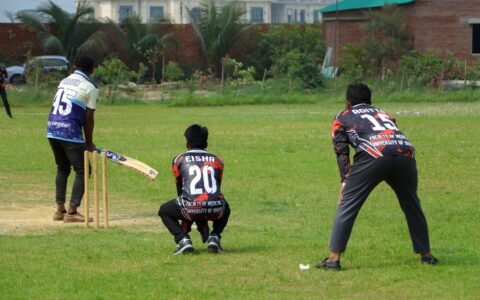
One of the most unusual developments in sports corruption is the emergence of “synthetic” or staged cricket tournaments. In these schemes, the sporting event itself is a complete fabrication, organized solely as a physical backdrop to generate live data feeds for offshore betting markets.
The Molipur Staged IPL Scam
In July 2022, the Gujarat Police dismantled a highly organized betting operation in Molipur village, Mehsana district. The syndicate leased a remote patch of agricultural land adjacent to a local cemetery and transformed it into a simulated stadium, complete with a prepared pitch, boundary ropes, high-definition cameras, and professional-grade halogen lighting towers for night broadcasts.
To populate the field, the organizers hired local farm laborers and unemployed youth for ₹400 per match. These laborers were dressed in replica jerseys of prominent IPL franchises, including the Chennai Super Kings, Mumbai Indians, and Gujarat Titans. To ensure the players looked authentic to online viewers, a key organizer, Shoeb Davda—who had worked in a Russian pub specializing in sports gambling—trained the laborers in realistic body movements and professional bowling and batting postures.
The match broadcast was designed to deceive remote viewers placing bets through encrypted Telegram channels, primarily located in Russian cities such as Moscow, Voronezh, and Tver. The syndicate live-streamed the matches on a dedicated YouTube channel named “IPL”. To execute the deception, they employed several sophisticated broadcast techniques:
- Controlled Camera Angles: The camera operators used close-up tracking shots of the pitch and players, purposefully avoiding wide shots that would reveal the empty farmland and lack of spectators.
- Synthetic Atmosphere: The broadcast audio track mixed pre-recorded crowd noise downloaded from the internet to simulate a stadium atmosphere.
- Commentary Mimicry: A local commentator was hired specifically for his ability to mimic the distinctive voice, tone, and delivery style of famous Indian commentator Harsha Bhogle.
- Real-Time Score Graphics: The stream integrated computer-generated graphics to display live scoreboards, match statistics, and overs.
The actual play on the field was entirely dictated by the betting volumes received on the Telegram channels. The Russian mastermind, identified as Asif Mohammad, monitored the incoming bets and communicated instructions to the fake on-field umpire via walkie-talkies. The umpire would then signal the bowler and batsman to deliver a specific outcome, such as hitting a six, a four, or intentionally getting out. The operation ran successfully into its quarterfinal stage, securing over ₹300,000 in betting deposits, before a law enforcement raid disrupted the tournament mid-match.
The UP “Big Bash Punjab T20” Racket
A similar synthetic league was uncovered in the Hapur district of Uttar Pradesh, operating for over six months. This syndicate streamed fabricated matches on a YouTube channel named “Big Bash Punjab T20” and utilized CricHeroes, a legitimate cricket scoring and streaming application, to publish their data.
The Hapur organizers hired local players but registered them under the names of genuine Ranji Trophy and state-level cricket players to deceive gamblers. This operation was funded by Ashok Chaudhary, a Meerut-based operator residing in Russia, who paid the local organizers approximately ₹80,000 per match to cover ground rental, player wages, and high-definition broadcasting equipment.
| Parameter | Molipur (Gujarat) Scheme | Hapur (Uttar Pradesh) Scheme |
| Broadcasting Platform | YouTube (“IPL”) | YouTube (“Big bash Punjab t20”) |
| Statistical Application | CricHeroes | CricHeroes |
| Match Control Mechanism | Walkie-talkie signals to umpires based on Russian bets | Pre-arranged structures utilizing local ground rentals |
| Player Roster Deception | Unemployed laborers paid ₹400 per game dressed in IPL jerseys | Local players passed off under real Ranji Trophy player names |
| Mastermind Identity | Shoeb Davda & Russia-based Asif Mohammad | Russia-based Ashok Chaudhary (Meerut Academy) |
| Financial Scale | ₹300,000 initial installment recovered | ₹80,000 paid to local organizers per match |
Elite Talent Selection Scams and Youth Exploitation
The high financial rewards and social mobility associated with professional cricket have also made career opportunities a key target for fraud. Aspiring young cricketers and their families are routinely targeted by career selection scams that exploit their dreams of reaching elite levels.
Social Media Exploitation of Youth Aspirations
The most financially devastating format of these scams involves fraudsters impersonating talent scouts or team selectors on social media. In Belagavi, Karnataka, a 19-year-old local cricketer, Rakesh Yadure, was targeted after posting video highlights of his performance in a state-level tournament in Hyderabad.
A fraudster operating under a spoofed Instagram account, Sushant_srivastava1, contacted Yadure, claiming to be an official scout for the Rajasthan Royals. The fraudster claimed that Yadure had been shortlisted for the franchise’s development squad, offering a contract with promised match fees ranging from ₹40,000 to ₹8 lakh per game. To finalize his selection, Yadure was instructed to fill out an online application and pay an initial registration fee of ₹2,000.
Over the following four months, the fraudsters exploited the family’s hopes by demanding escalating payments for “medical clearances,” “insurance bonds,” “training camp fees,” and “official match fees”. Yadure’s father, a low-income security guard, took out high-interest personal loans to cover these costs, transferring a total of ₹23.53 lakh to the fraudsters before they cut off contact. A subsequent cybercrime investigation tracked the digital footprint to the Sultanpur district of Uttar Pradesh, where police arrested two suspects, Susanjan and Diwakar, the former of whom was identified as a repeat offender using the same modus operandi.
Fraudulent Academies and Domestic Cricket Bribery
This career-based fraud also targets institutional entry points. The Board of Control for Cricket in India (BCCI) was forced to issue a formal media advisory warning the public about fake advertisements offering guaranteed entry into the prestigious National Cricket Academy (NCA) in Bengaluru in exchange for a fee. The BCCI clarified that the NCA is strictly merit-based, does not charge athletes for the use of its facilities, and restricts access entirely to BCCI-contracted players, designated target groups, and athletes officially recommended by State Associations.
In Delhi, the Crime Branch arrested cricket coaches Ravi Dalal and Harish Jamal for running a selection racket. Operating out of the Friends Cricket Academy in Pitampura, Dalal solicited large sums of money from aspiring players under the pretext of securing them “guest player” spots on state Ranji Trophy teams. One victim, Kanishk Gaur, was defrauded of ₹11 lakh on the promise of playing for the Nagaland Ranji Trophy team. To pull off the deception, the coaches forged birth certificates and regional registration documents, allowing the victim to play in only two Under-19 matches before he was removed from the squad.
This institutional vulnerability was further highlighted by a 2018 sting operation that exposed Akram Saifi, the personal executive assistant to then-IPL Chairman and Uttar Pradesh Cricket Association (UPCA) Secretary Rajeev Shukla. The sting revealed audio recordings of Saifi soliciting bribes in cash and personal favors from a local cricketer, Rahul Sharma, in exchange for securing his selection in the state team and issuing fake age certificates.
| Case Parameters | Belagavi Youth Fraud | Delhi Academy Bribery | UPCA Bribery Sting |
| Target Victim | Rakesh Yadure (19), aspiring regional cricketer | Kanishk Gaur & Kishan Attri (Rohini), Shivam Sharma | Rahul Sharma, domestic cricketer |
| Accused Parties | Susanjan & Diwakar (UP-based fraudsters) | Ravi Dalal (Friends Academy) & Harish Jamal | Akram Saifi (Executive EA to IPL Chairman) |
| Impersonated Role | Official Rajasthan Royals Talent Scouts | Connected regional state coaches & academy scouts | Highly placed state administrative official |
| Financial Extraction | ₹23,53,550 via multiple online transfers | ₹11 lakh (Gaur), ₹4 lakh (Sharma) in cash | Bribes requested in “cash and kind” |
| Fraud Mechanism | Friend request on Instagram; fake selection camp forms | Document forgery (birth certificates) for guest entry | Verbal solicitation of favors for selection |
Anti-Corruption Protocols, Technical Interventions, and Governance
To combat these evolving threats, sports governing bodies and law enforcement agencies have developed specialized regulatory frameworks, monitoring technologies, and reporting protocols.
BCCI Anti-Corruption Unit Protocols
The BCCI’s Anti-Corruption Unit (ACU) operates under a comprehensive Anti-Corruption Code that binds all players, coaches, selectors, and support staff. Under this code, participants are legally obligated to immediately report any corrupt approach or unusual activity to the ACU; failure to do so is a punishable offense.
To monitor modern betting patterns, the BCCI partners with specialized integrity firms, such as the UK-based Sportradar. This partnership utilizes Sportradar’s Fraud Detection Services (FDS), which employs mathematical algorithms to analyze live betting odds across more than 600 independent global bookmakers, processing over 5 million data points daily. The system uses historical baselines to flag betting anomalies in real-time.
- Pre-Match Alerts: The system uses 44 pre-match parameters to identify abnormal shifts in odds before a game begins, which may indicate insider information or pre-arranged outcomes.
- Live Match Alerts: The system tracks 25 in-play metrics, immediately flagging instances where live betting odds deviate significantly from expected statistical models, indicating potential spot-fixing.
Player and Match Officials Area (PMOA) Security
Because players are increasingly approached through digital channels, the BCCI has implemented strict security measures within the Players and Match Officials Area (PMOA) on match days. Players are required to deposit all personal communication devices, including mobile phones and smartwatches, with designated Security Liaison Officers (SLOs) before entering the PMOA.
In 2026, the BCCI expanded this ban to include “smart sunglasses” or smart goggles. These devices, equipped with integrated Wi-Fi, Bluetooth, and cellular capabilities, allow covert live-streaming and audio-video communication directly from the field or dugout. Under the PMOA Minimum Standards, these glasses are classified as communication and recording devices; possession within the PMOA is a code violation subject to disciplinary action and financial penalties. Additionally, the BCCI has restricted access to team hotels, banning unauthorized guests and late-night outings to protect players from potential honey-trapping and corrupt approaches.
Governance and Reporting Mechanisms
To protect the integrity of the sport and shield the public from these multi-vector scams, both international and domestic governing bodies maintain dedicated anti-corruption units and hotlines. These units encourage players, coaches, administrators, and the general public to report any suspicious activity, fraudulent selection advertisements, or corrupt approaches through official, secure channels.
| Governing Body | Designated Officer / Unit | Official Contact Channel |
| International Cricket Council (ICC) | International Anti-Corruption Unit (ACU) | +971565458909 (Hotline); contactACU@icc-cricket.com |
| Board of Control for Cricket in India (BCCI) | Shabir Khandwawala / Sharad Kumar (ACU) | +917506003000 (Hotline); integrity@bcci.tv |
| Cricket Australia (CA) | Jacqui Partridge (Integrity) / Stuart Bailey (ACU) | 1300 3247 4263 (1300 FAIR GAME); integrity@cricket.com.au |
| England and Wales Cricket Board (ECB) | Ryan Smith (Anti-Corruption Manager) | 0845 265 8000 / 0800 389 0031; anti-corruption@ecb.co.uk |
| Pakistan Cricket Board (PCB) | Col. Usman Anwari (Senior ACU Manager) | +923003414141 / +923000705622; usman.anwari@pcb.com.pk |
| Bangladesh Cricket Board (BCB) | Major Raiyan Azad / Abu M. H. Morshed | +8801785037848 / +8801713046522; acu@bcb-cricket.com |