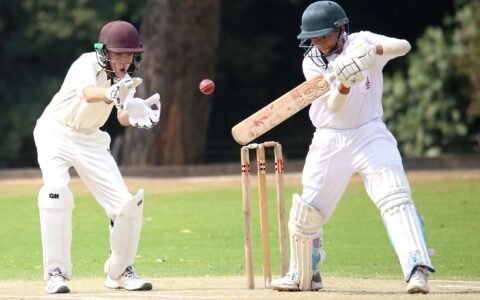
On October 1, 2026, cricket’s rulebook gets its most comprehensive rewrite in years. The Marylebone Cricket Club — custodians of the Laws of Cricket since 1788 — has announced 73 material changes to the Laws, effective simultaneously across all levels of the game from international cricket down to club and junior competitions. Some are technical refinements. Several are substantive shifts that will change how the game is played, how catches are adjudicated, and what equipment is legal for the first time in the sport’s professional era.
This piece covers every significant change — what the old law said, what the new law says, and what it means in practice.
Laminated Bats: The Biggest Equipment Change in Decades
For the entirety of professional cricket’s modern era, the Laws required bats to be made from a single piece of willow with a cane handle. That restriction is gone from October 2026. Type D laminated bats — constructed from up to three pieces of wood bonded together — are now permitted in adult cricket for the first time.
The context matters here. English willow, the preferred bat material for elite cricket, has become significantly more expensive over the past decade as the supply of high-grade clefts has tightened. A professional-quality English willow bat now costs between £300 and £700. Kashmir willow — lighter-grained and cheaper — has been the affordable alternative, but it doesn’t perform comparably under professional conditions. Laminated construction, which bonds pieces of willow together to create a consistent hitting surface, has been legal in junior cricket for years. It produces equipment that performs closer to high-grade English willow at a fraction of the cost, and it is more sustainable, using smaller pieces of timber rather than requiring a single large-grade cleft.
The MCC conducted extensive performance testing before approving the change for adult cricket, concluding that Type D laminated bats do not offer a meaningful performance advantage over a traditional single-piece willow bat. The change is about cost and sustainability, not about giving batsmen an equipment edge. For recreational cricketers and players in countries where access to quality willow has always been a barrier, it is potentially the most practically significant rule change in this package.
Standardised Ball Sizes: Three Clear Categories
Cricket balls have historically existed in a range of sizes with overlapping specifications that created confusion for manufacturers, junior coaches, and clubs running mixed-age programmes. The 2026 Laws establish three clear, standardised categories that replace the previous overlapping system:
- Size 1 — the men’s adult cricket ball, used in all open-age men’s competition
- Size 2 — the women’s cricket ball, standardised for all women’s and girls’ competition above a specified age threshold
- Size 3 — the junior ball, for younger age-group cricket
Each size has uniform circumference margins across all manufacturers. The practical benefit is that a size specification now means the same thing regardless of which manufacturer produced the ball, removing the confusion that arose when different brands’ balls varied within the old overlapping ranges. For youth development coaches managing transitions between age groups, and for manufacturers producing for global markets, the simplification is long overdue.
The Stop Clock Comes to Test Cricket
The stop clock was introduced in T20 internationals and ODIs as a response to slow over rates — one of cricket’s most persistent spectator complaints. The mechanism is simple: fielding teams must begin the next over within a fixed time after the previous one ends, with a five-run penalty applied to the batting side if the clock is breached. In white-ball cricket, it has worked. Over rates in T20 matches have improved since its introduction.
From October 2026, the stop clock extends to Test cricket and all multi-day formats. The specific application differs slightly in multi-day cricket — the penalty structure and clock duration are calibrated for the longer format — but the principle is the same. Fielding teams that dawdle between overs, taking extended time to set fields and shuffle bowlers, will now face consequences rather than simply a fine applied retrospectively after the match.
Slow over rates in Test cricket have been a regulatory failure for decades. The post-match docking of ICC ranking points has not functioned as a genuine deterrent — teams accept the penalty as a cost of doing business. The in-match stop clock changes the economic calculation: the cost of a slow over rate is immediately visible to the batting side, and the pressure to maintain pace falls on the fielding captain rather than being deferred to a match referee’s report.
Final Over Must Be Completed
Under the old Laws, if a wicket fell in the final over of a day’s play, the day ended at that point. The incoming batsman did not have to walk in; the remaining deliveries in the over were simply lost. This created an obvious incentive imbalance: the fielding side was deprived of the balls remaining in the over if they took a wicket, even though bowling a batsman out is precisely the outcome they were working toward.
The 2026 Laws correct this. If a wicket falls in the final over of any day’s play in multi-day cricket, the remaining deliveries must still be bowled. A new batsman must come in and face the remaining balls in the over, regardless of how many are left. The day does not end until the over is complete.
The impact on end-of-day cricket will be significant. Captains managing the final over of a day now face a genuine decision: bowl your most dangerous bowler knowing that a wicket means the new batsman faces the over’s remaining deliveries rather than coming in fresh the next morning — or preserve the wicket scenario for the opening over of the following day. Conversely, batsmen in the final over now know that a dismissal sends the next player in immediately, which changes the risk calculus around playing attacking shots when the day is almost over.
The “Bunny Hop” Catch Is Banned
Over the past decade, fielders near the boundary developed a technique that exploited a gap in the Laws: a fielder who had gone outside the rope could palm the ball upward while airborne, hop back inside the boundary, land, and complete the catch. Because the fielder was airborne when they touched the ball (technically still “inside” in terms of their contact with the ball before grounding outside), the catch was deemed legal. The result was a series of spectacular but widely-criticised catches where a fielder who had clearly left the field of play completed a dismissal that most observers felt should have been a six.
The new Law closes this precisely. A fielder who has gone outside the boundary may touch the ball while airborne only once. Having done so, they must then be wholly grounded inside the boundary for the remainder of that delivery — no second contact, no relay, no hop. If the fielder is beyond the rope at any point after their initial touch, the ball is a six.
The relay catch scenario is also addressed explicitly. If Fielder A touches the ball outside the boundary and throws it to Fielder B inside, Fielder A must still get back inside the boundary before Fielder B completes the catch. If Fielder A remains beyond the rope when Fielder B catches the ball, the catch does not count — it is a six. This closes the second loophole: teams cannot simply relay the ball to a second fielder inside the boundary to circumvent the requirement for the original fielder to ground themselves inside.
Overthrows Redefined
The overthrow law has been one of the most contested areas of cricket law in recent years, producing contentious penalty decisions in high-profile matches. The central problem was that the definition of an overthrow was broad enough to encompass misfields and deflections near the boundary that, under any natural reading of the word, felt more like accidents than overthrows.
The 2026 Laws narrow the definition: an overthrow is now specifically an intentional attempt to run out or hit the stumps. A ball that deflects off a fielder near the boundary and goes over the rope without any deliberate throw being involved no longer qualifies as an overthrow — it is simply a misfield that went to the boundary, and only the original runs plus four are awarded. This removes the category of penalty runs that arose from incidental deflections rather than genuine throws.
The most notorious case in recent memory was the 2019 World Cup final — England vs New Zealand — in which a deflection off Ben Stokes’s bat while he attempted a dive resulted in the ball reaching the boundary, producing six runs (four overthrow penalty runs plus the two already run). The sequence was legal under the existing Laws but felt fundamentally wrong to most observers. The new definition would not change the outcome of that specific sequence (it involved a genuine throw by a fielder), but the spirit of the revision is to tighten overthrow penalties to situations involving deliberate throwing actions rather than accidental deflections.
What Happens from October 1
The 73 changes take effect simultaneously across all levels of cricket on October 1, 2026. The MCC has published the changes now — months in advance of the effective date — specifically to allow players, coaches, umpires, and clubs time to absorb them before they come into force. The major playing conditions adopted by the ICC may vary slightly in implementation (as they always have — the Laws provide the framework, and playing conditions apply them to specific competitions), but the core Laws are the foundation from which all playing conditions derive.
For club and recreational cricketers, the most immediately relevant changes are the laminated bat legalisation (which affects equipment purchasing decisions) and the final-over completion rule (which changes end-of-day tactics in any multi-day format). For professional cricket, the stop clock extension to Tests will be the change with the most visible daily impact. For fielding coaches and captains thinking about boundary fielding assignments, the bunny-hop ban will require adjustments to how fielders are positioned and how they approach high catches near the rope.
Cricket’s Laws do not change often. When they do, it is worth understanding precisely what changed and why — because the Law changes reflect what the game’s custodians believe the sport needs at this moment: more accessible equipment, simpler ball specifications, faster over rates, and fielding rules that match what most people watching actually believe the game should look like.
FAQ
Are laminated bats allowed in international cricket from 2026?
Yes. From October 1, 2026, Type D laminated bats — constructed from up to three pieces of wood bonded together — are permitted in adult cricket at all levels, including international cricket. The MCC determined after extensive testing that laminated bats do not offer a significant performance advantage over traditional single-piece willow bats. The change is primarily aimed at reducing equipment costs and improving sustainability by reducing dependence on large single-grade willow clefts.
What is the new bunny hop catch rule in cricket?
From October 2026, a fielder who goes outside the boundary may touch the ball while airborne only once. After that contact, they must be fully grounded inside the boundary — no second touch, no hop back. If they touch the ball, leave the boundary, and a teammate completes the catch, the original fielder must also return inside before the catch is completed, or the ball is counted as a six. The rule eliminates the technique of palming the ball upward while airborne beyond the rope and hopping back inside to complete the catch.
How many law changes did the MCC make for 2026?
The MCC announced 73 material changes to the Laws of Cricket in the 2026 edition, effective October 1, 2026. The most significant include: laminated bats legalised for adult cricket; standardised ball sizes (Size 1, 2, 3); stop clock extended to Test cricket; final over of a day’s play must be completed even if a wicket falls; the bunny-hop boundary catch banned; and the overthrow definition narrowed to intentional throwing actions only.