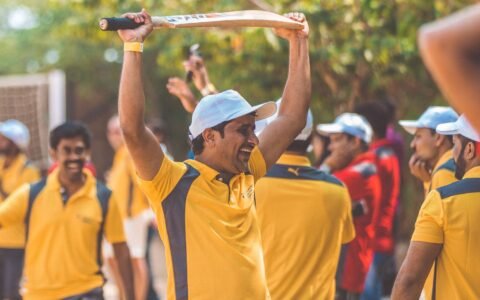
Sachin Ramesh Tendulkar did not merely play cricket. He redefined what a batsman could be. Across 24 years of international cricket, spanning two decades of the sport’s greatest transformation, Tendulkar compiled numbers that statisticians still struggle to contextualise fully — 100 international centuries, 34,357 runs across all formats, and a career that began when India was still debating whether satellite television was a good idea and ended in the age of Twitter and DRS.
The Boy from Shivaji Park
Sachin was born on April 24, 1973 in Mumbai, the youngest of four children in the Tendulkar household. His father, Ramesh Tendulkar, was a respected Marathi novelist and professor. The family lived in the Bandra neighbourhood but it was the concrete pitches and narrow lanes of Shivaji Park in Dadar that would shape the young Sachin’s game.
At age eleven, he came under the tutelage of Ramakant Achrekar, a legendary cricket coach who would become far more than just a technical instructor. Achrekar recognised something unusual in the boy — a stillness in his back-foot movement that coaches spend careers trying to instil. He placed a one-rupee coin on the top of the stumps, offering it to any bowler who could dismiss young Sachin in the nets. Tendulkar collected thirteen such coins before he turned sixteen. He kept every one of them.
In 1988, Tendulkar and his school partner Vinod Kambli put on an unbroken stand of 664 runs in a Harris Shield match — still an unbroken world partnership record in any cricket. The scorecard read: Tendulkar not out 326. He was fifteen years old.
The Debut That Changed Everything
On November 15, 1989, in Karachi, a 16-year-old Sachin Tendulkar walked out to bat for India against one of the most formidable bowling attacks assembled in that era. Imran Khan, Wasim Akram, Waqar Younis — who was also making his debut that day — and Abdul Qadir had reduced India to tatters. Waqar’s short delivery split Tendulkar’s lip, drawing blood. Play stopped. The physio came on. Teammates expected the teenager to retire hurt.
He waved the physio away, took guard again, and faced the next ball with the same calm expression he would carry throughout his career. He scored 15 runs in that innings. In cricket terms it was a minor contribution. In every other sense, it announced everything.
The Records: A Statistical Universe
The numbers that define Tendulkar’s career are so extreme they require careful framing to appreciate:
- 100 international centuries — the nearest rival, Ricky Ponting, stopped at 71.
- 51 Test centuries in 200 Test matches, averaging 53.78.
- 49 ODI centuries from 463 matches, with an average of 44.83.
- 15,921 Test runs — the all-time record, nearly 2,000 more than the second-highest scorer.
- 18,426 ODI runs — also the all-time record.
But statistics compress the truth. They do not capture the standing ovation at Lord’s in 1990 when a 17-year-old scored his maiden Test century against England. They do not register the Desert Storm innings of 143 against Australia in Sharjah in 1998, played under a sandstorm — described by Shane Warne as the most devastating batting exhibition he had ever fielded against.
The Weight of a Nation
To understand Tendulkar fully, you have to understand what cricket means in India. When he batted, an estimated 200 to 300 million people stopped what they were doing. Railway stations fell quiet. Street food stalls shut their flames. Families gathered around single television sets in villages that had power for only eight hours a day.
This weight — the expectation of a billion people compressed into one man’s innings — would have broken most athletes. Tendulkar carried it for 24 years. He rarely cracked publicly. In March 2012, in Dhaka, he finally reached that hundredth international century against Bangladesh. When the moment arrived and the crowd erupted, he raised his bat slowly, eyes closed, releasing 24 years of carried weight all at once.
The Technique
Tendulkar’s batting technique was a masterclass in compactness and efficiency. He hit through the V with exceptional control, played the pull shot with more variety than any other batsman of his generation, and possessed a straight drive of such purity that coaches still use old footage of it in academies across India.
Against Shane Warne, he developed a pre-meditated strategy that involved charging down the pitch before the ball was delivered, unsettling the bowler’s length. Against fast bowlers above 145 km/h, he remained still at the crease far longer than his contemporaries, waiting until the last possible moment before committing to the shot.
2011: The Crowning Achievement
Despite every individual record, Tendulkar had one absence on his CV that hurt: a World Cup winner’s medal. India had won in 1983 and then waited 28 years. In 2011, at 37, he played his final World Cup and scored 482 runs across the tournament. In the final against Sri Lanka in Mumbai — in his home city, at the Wankhede Stadium — India won by six wickets. His teammates carried him around the ground on their shoulders. He wept.
Legacy
What is inarguable is the scale and the longevity. Twenty-four years. Two hundred Tests. One hundred international centuries. And throughout that entire period, not a single ball-tampering scandal, not a match-fixing allegation, not a single moment that compromised the integrity of what he represented.
Cricket occasionally produces a figure who transcends the game. Sachin Tendulkar was one such figure. He will not come around again.